A Practical Guide to ASCE 38 SUE Quality Levels for Texas Transportation and Municipal Projects
A clear, practical explanation of ASCE 38 SUE quality levels (QL‑D through QL‑A), guidance on which levels to require at different design milestones for highways, ports, and municipal roads in Texas, and considerations owners should use when scoping SUE work.

Why subsurface utility engineering (SUE) matters for Texas infrastructure
Undetected or poorly characterized underground utilities are a common source of construction delays, change orders, safety incidents, and redesign on transportation and municipal projects. For long linear projects such as highways, complex facilities such as ports, and urban municipal streets, early and appropriately scoped SUE reduces risk by improving the accuracy of utility information used for design, coordination, and permitting. Owners and designers in the Greater Houston area and across Texas benefit when SUE outputs are matched to project complexity and key decision points.
Overview of ASCE 38 quality levels (QL‑D through QL‑A)
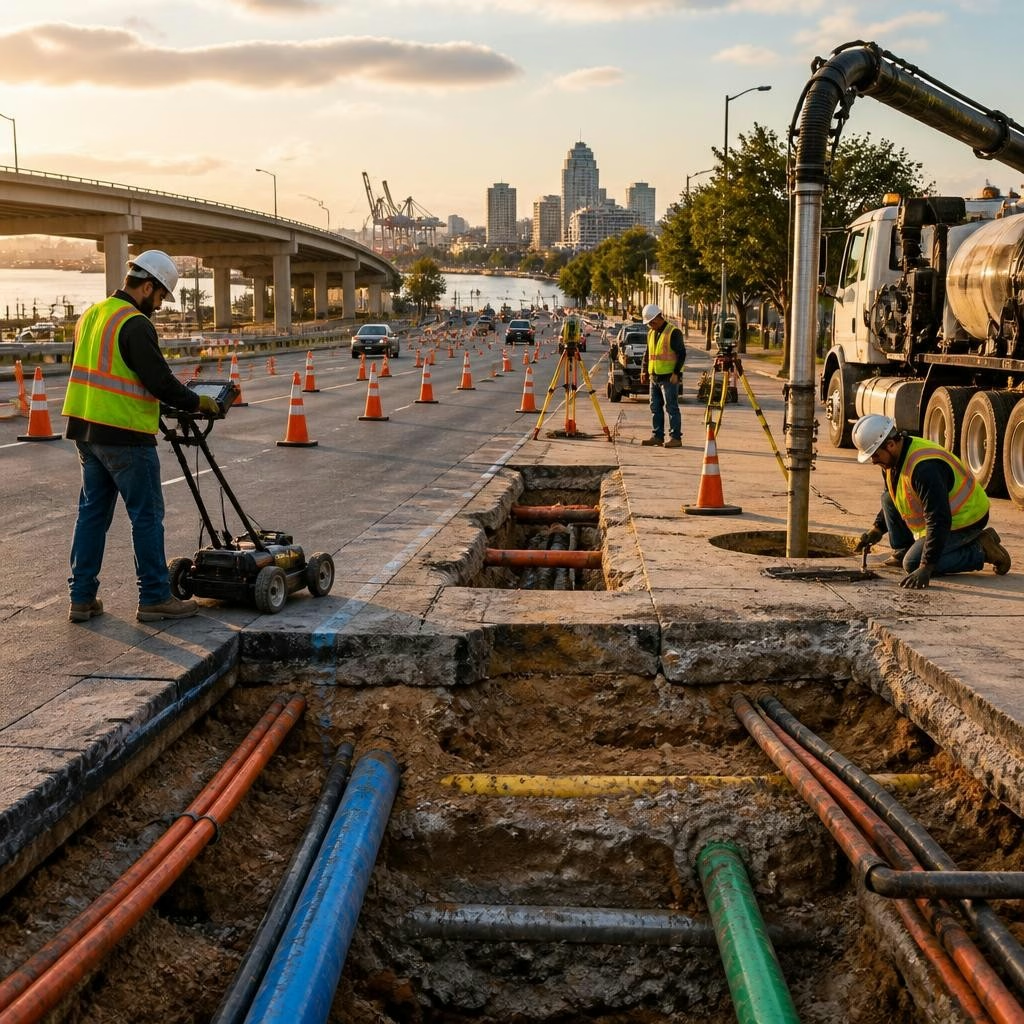
ASCE 38 defines progressive quality levels that describe the confidence in utility location and attributes. QL‑D reflects information compiled from existing records, utility company maps, and verbal histories—useful for early planning but not for detailed design. QL‑C supplements QL‑D with site reconnaissance and visible above‑ground utility features to correlate records to the field. QL‑B relies on nondestructive geophysical methods (for example, electromagnetic locating or ground‑penetrating radar) to determine horizontal position and inferred depth. QL‑A is the highest confidence level and requires direct exposure of the utility (for example by vacuum excavation or hand‑dug potholing) to confirm exact horizontal and vertical position. Each level improves certainty and supports different project decisions.
Which quality levels are appropriate at common design milestones
Match the SUE quality level to the decisions to be made at each design stage. During feasibility and corridor selection, QL‑D or QL‑C typically provide adequate situational awareness and cost estimating. For preliminary design and alignment development, QL‑B is often appropriate to identify likely utility conflicts and refine horizontal alignment. For final design, construction plan preparation, and utility relocation design, require QL‑A for areas where utilities will be relocated, protected, or crossed at tight tolerances. Owners can specify a staged approach—progressive upgrades from QL‑D/C to QL‑B to QL‑A—so that higher‑cost excavation is focused where it yields the greatest benefit.
Project‑type considerations: highways, ports, and municipal roads
Different project types shift the balance between corridor length, density of utilities, and tolerance for risk. Highways and long linear projects often use QL‑B corridorwide during preliminary design to screen conflicts and then QL‑A at interchanges, bridges, and major crossings. Port facilities and heavy industrial areas typically require QL‑A at critical berths, service corridors, and locations with deep or congested utilities because of heavy equipment loads and constructability constraints. Municipal roadway projects—especially in dense urban neighborhoods—frequently combine QL‑B for general alignment work with QL‑A at proposed tie‑ins, curb returns, or locations adjacent to sensitive structures. Tailor the approach to the section of corridor and the severity of potential conflicts.
How owners should scope SUE contracts and deliverables
A clear SUE scope reduces ambiguity and aligns expectations. Owners should specify required QLs by corridor segment or by design milestone, describe expected deliverables (for example, ASCE 38‑compliant reports, annotated plans, and digital CAD or GIS layers), identify data standards and coordinate systems, and set requirements for recordkeeping and quality control. Include provisions for traffic control, permits, utility owner notifications, and access to private property if potholing is required. Defining acceptance criteria for when QL‑A is required (for instance, all proposed utility relocations and crossings) helps manage cost and schedule while ensuring critical locations receive direct confirmation.
Integrating SUE with utility coordination, monitoring, and design support
SUE is most effective when it is integrated with utility coordination and construction verification. Accurate SUE data informs utility relocation plans, helps negotiate agreements and permits, and reduces surprises during construction. During construction, monitoring and verification services validate that installed utilities match plans and identify discrepancies early. Deliverables such as coordinated utility plans, CADD support, and quality control records make it easier for designers, contractors, and owners to act on SUE findings. Including on‑site verification and training presentations in the scope can also improve field outcomes and reduce rework.
Next steps for owners and project teams in Greater Houston
Start SUE planning early: define project decision points, map areas of high utility conflict, and budget for staged investigations that escalate to QL‑A only where necessary. Require clear deliverables and a data format that integrates with your design workflows. For owners and teams in the Greater Houston area, engaging a firm experienced in SUE, utility coordination, monitoring, and CADD support helps translate ASCE 38 requirements into a practical, risk‑based program for your project. Gabrielle Martinez Utility Engineering Consultants, LLC provides Subsurface Utility Engineering and related utility coordination services and can assist owners in scoping SUE work to fit the scale and risk profile of highways, ports, and municipal road projects.
Article by
Gabrielle Martinez Utility Engineering Consultants, LLC
Civil Engineering firm specializing in Utility Coordination & Engineering, Subsurface Utility Engineering (SUE), and Utility Monitoring & Verification for complex civil infrastructure projects across the Greater Houston area, including highways, urban and municipal roads, ports, and private development work. Serving the Greater Houston area with precision subsurface utility engineering, proactive utility coordination, utility inspection services, and CAD support services. We empower civil engineering teams to move forward with confidence. Whether you’re a public agency, land developer, or surveyor needing to locate utilities, our team is ready to support your next project.